
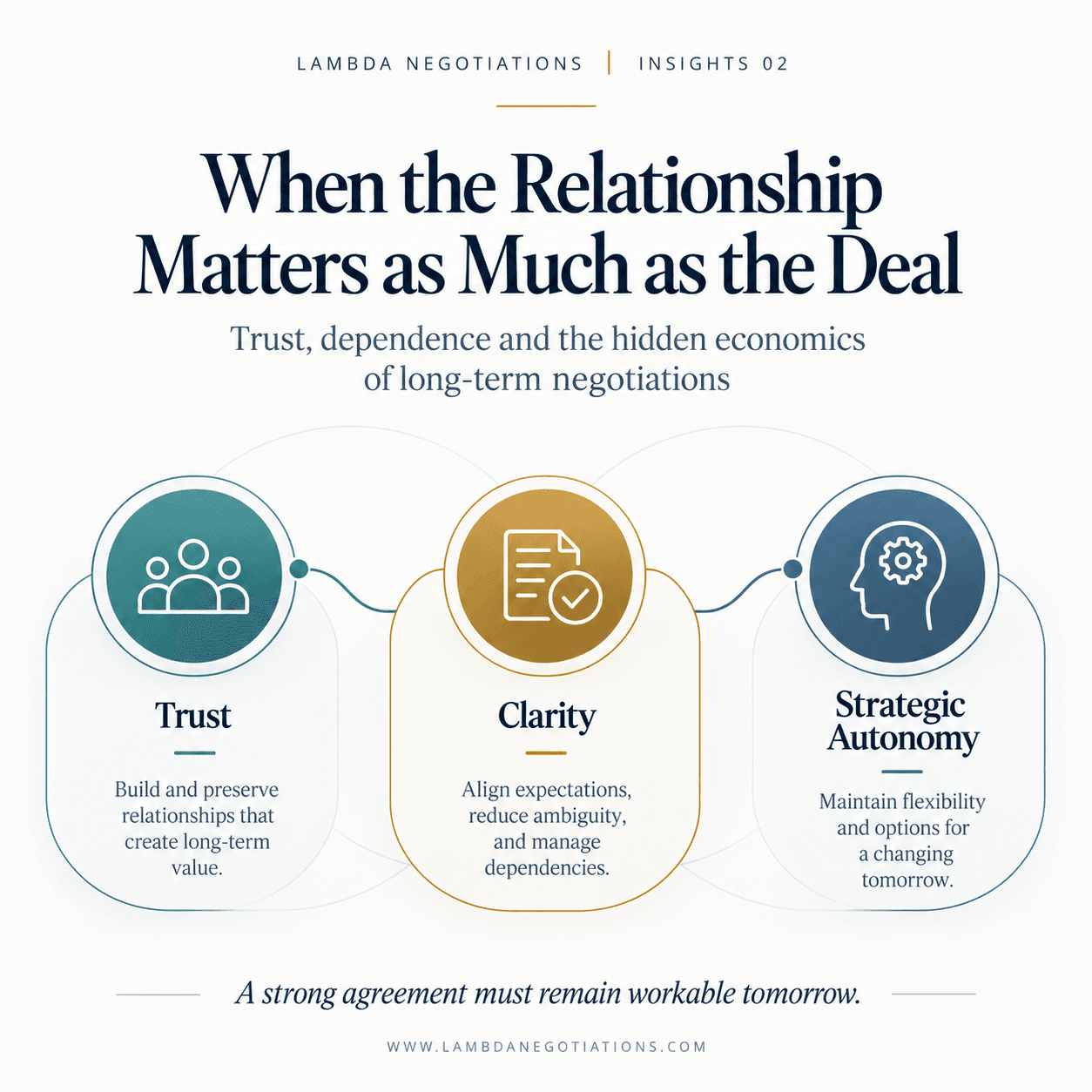
A negotiation can produce an attractive agreement and still weaken the relationship on which its success depends. Equally, a difficult negotiation can strengthen a partnership when it clarifies expectations, addresses unresolved tensions and establishes a more sustainable basis for cooperation. The difference lies in understanding that a business relationship is not simply the environment in which negotiation takes place. Frequently, it is one of the most valuable assets being negotiated.
For senior executives, this distinction has significant consequences. Commercial partnerships, strategic alliances, supplier relationships and institutional cooperation rarely end when a contract is signed. Their economic value develops through subsequent decisions, shared commitments and the ability of the parties to respond when circumstances change. Negotiating successfully therefore requires an assessment of both the immediate agreement and the relationship that must support its implementation.
The Economic Value of a Relationship
Traditional assessments of negotiation outcomes often emphasize price, contractual conditions and the distribution of financial benefits. These indicators matter, but they provide an incomplete account of value in relationships involving repeated interaction.
Dyer and Singh (1998), in their influential relational view of competitive advantage, demonstrate theoretically how value can arise between organizations through complementary resources, knowledge-sharing routines, relationship-specific investments and effective governance. In such circumstances, competitive advantage may depend not only on what individual firms possess, but also on what they are capable of achieving together.
Consider a hypothetical cruise company negotiating a long-term commercial arrangement with a destination service provider. The immediate discussion may concern service charges, capacity commitments and operational responsibilities. Yet the partnership's broader value may depend on coordination during unexpected disruptions, responsiveness to changing passenger requirements and the reliability of information exchanged between the parties.
A reduction in charges may improve short-term financial performance while weakening the service provider's ability to maintain the operational capacity required for future performance. Conversely, accepting higher costs without corresponding commitments may create an inefficient and increasingly dependent relationship.
The strategic question is not whether the relationship should take priority over commercial interests. It is how the relationship contributes to those interests and what conditions are necessary to preserve its value.
Trust Is Not the Absence of Protection
Trust is frequently presented as the foundation of successful cooperation. Yet executives should distinguish genuine trust from a willingness to accept poorly defined obligations.
Lewicki, McAllister and Bies (1998) challenge the assumption that trust and distrust are merely opposite ends of a single continuum. Their analysis suggests that relationships may contain confidence in certain dimensions while retaining legitimate concerns about others. A company might trust a partner's professional competence while questioning its commercial incentives or financial resilience.
This distinction matters because trust should not replace strategic scrutiny.
Poppo and Zenger (2002) provide empirical evidence that formal contracts and relational governance can function as complements rather than substitutes. Clear contractual provisions may support cooperation by reducing ambiguity, establishing expectations and creating procedures for handling disagreement.
Consequently, contractual precision is not necessarily evidence of distrust. It can demonstrate a commitment to protecting the relationship from misunderstandings that would otherwise undermine it.
A well-negotiated partnership does not depend on the assumption that problems will never arise. It establishes how the parties will respond when they inevitably do.
When Cooperation Becomes Dependence
Perhaps the most underestimated risk in long-term negotiation is the gradual transformation of cooperation into dependence. An arrangement that initially generates significant value may, over time, reduce the alternatives available to one party.
Our recent research on hotel-tour operator contracting, published in Tourism Critiques: Practice and Theory, examines how large intermediaries can exercise influence through their control over market access, demand information and contractual conditions (Papadopoulou-Kelidou, Antonakakis, & Page, 2026).
The findings illustrate an important distinction: maintaining a commercial relationship does not necessarily imply that the parties possess comparable bargaining power or derive equivalent benefits from its continuation.
A hotel may regard a major distribution partner as essential to maintaining occupancy, while the partner may have access to numerous alternative accommodation providers. The relationship can be economically valuable to both parties while exposing one to substantially greater risks.
This is why strategic relationship management must include continuous assessment of alternatives, information asymmetries and the distribution of contractual obligations. Preserving a partnership should not mean allowing dependence to expand without examination.
A relationship becomes strategically fragile when maintaining it requires repeatedly sacrificing the ability to make independent decisions.
Understanding Both Negotiation Bases
The concept of the Negotiation Base, developed in our 2026 research, offers a structured way to examine this problem before it becomes a source of conflict.
Each negotiating party has its own configuration of interests, priorities, time horizons, risk preferences and expectations about future developments. These characteristics evolve as market conditions, dependencies and strategic objectives change.
Preparation must therefore consider two distinct but interconnected questions. What does our organization need from this relationship today and in the future? And what does the counterpart need, expect or fear from its continuation?
Differences between these two Negotiation Bases do not necessarily prevent agreement. They may create opportunities for arrangements that address different priorities across time.
One party may prioritize immediate financial certainty, while another values long-term commercial flexibility. Properly structured commitments, review mechanisms and risk-sharing arrangements may accommodate both interests without requiring either party to abandon its essential objectives.
The difficult part is not identifying these possibilities in theory. It is determining which assumptions about the other party are supported by evidence and which require further investigation.
Difficult Conversations Can Protect Valuable Relationships
Executives sometimes postpone difficult negotiations because they fear damaging an established partnership. Yet unresolved disagreements rarely disappear simply because they remain unspoken.
The purpose of strategic negotiation is not to avoid conflict at all costs. It is to distinguish disagreements that threaten the relationship from disagreements that could improve its underlying structure if addressed constructively.
This requires clarity about non-negotiable interests, credible alternatives, decision-making authority and the consequences of continued disagreement. It also requires sufficient independence to challenge existing arrangements without allowing the discussion to become unnecessarily personal or confrontational.
In complex partnerships involving several organizations, effective dialogue may also depend on identifying parties whose approval or cooperation is necessary but whose interests are not adequately represented in the formal negotiation.
Relationships become more resilient when legitimate differences can be examined openly and translated into workable commitments.
The Agreement Is Only the Beginning
The quality of a negotiation ultimately becomes visible after the agreement has been reached. Its provisions must be implemented, expectations tested and unforeseen developments managed.
For this reason, senior executives should evaluate not only the terms they can secure today, but also the conditions under which tomorrow's cooperation will remain viable.
The strongest business relationships are not those in which the parties never disagree. They are those capable of accommodating disagreement without losing strategic clarity, mutual accountability or the ability to create value.
Before the next important negotiation, the essential question may therefore be different from the one executives usually ask. Rather than concentrating exclusively on what can be obtained from the counterpart, they should consider what kind of relationship the proposed agreement will create.
Because the value of a negotiation is measured not only by what the parties secure today, but also by what they remain capable of achieving together tomorrow.
From Research to Practice | Lambda Negotiations
At Lambda Negotiations, strategic preparation extends beyond individual bargaining positions to examine how relationships, dependencies, incentives and expectations influence consequential decisions.
The Preparation Room supports the analysis of both parties' Negotiation Bases before important agreements. Private Advisory offers confidential strategic reflection for executives facing difficult decisions within established relationships. Where multiple organizations must reconcile competing priorities, The Alignment Room supports structured dialogue and coordination.
Our purpose is not simply to help clients reach agreements, but to strengthen the quality of the strategic decisions on which sustainable cooperation depends.
Before it matters, prepare for it.
References
- Dyer, J. H., & Singh, H. (1998). The relational view: Cooperative strategy and sources of interorganizational competitive advantage. Academy of Management Review, 23(4), 660–679. https://doi.org/10.5465/amr.1998.1255632
- Lewicki, R. J., McAllister, D. J., & Bies, R. J. (1998). Trust and distrust: New relationships and realities. Academy of Management Review, 23(3), 438–458. https://doi.org/10.5465/amr.1998.926620
- Poppo, L., & Zenger, T. (2002). Do formal contracts and relational governance function as substitutes or complements? Strategic Management Journal, 23(8), 707–725. https://doi.org/10.1002/smj.249
- Papadopoulou-Kelidou, L., Antonakakis, N., & Page, S. J. (2026). Gatekeepers of demand: Lessons from pre-COVID hotel-tour operator contracting in the post-pandemic digital age. Tourism Critiques: Practice and Theory. https://doi.org/10.1108/TRC-01-2026-0002