
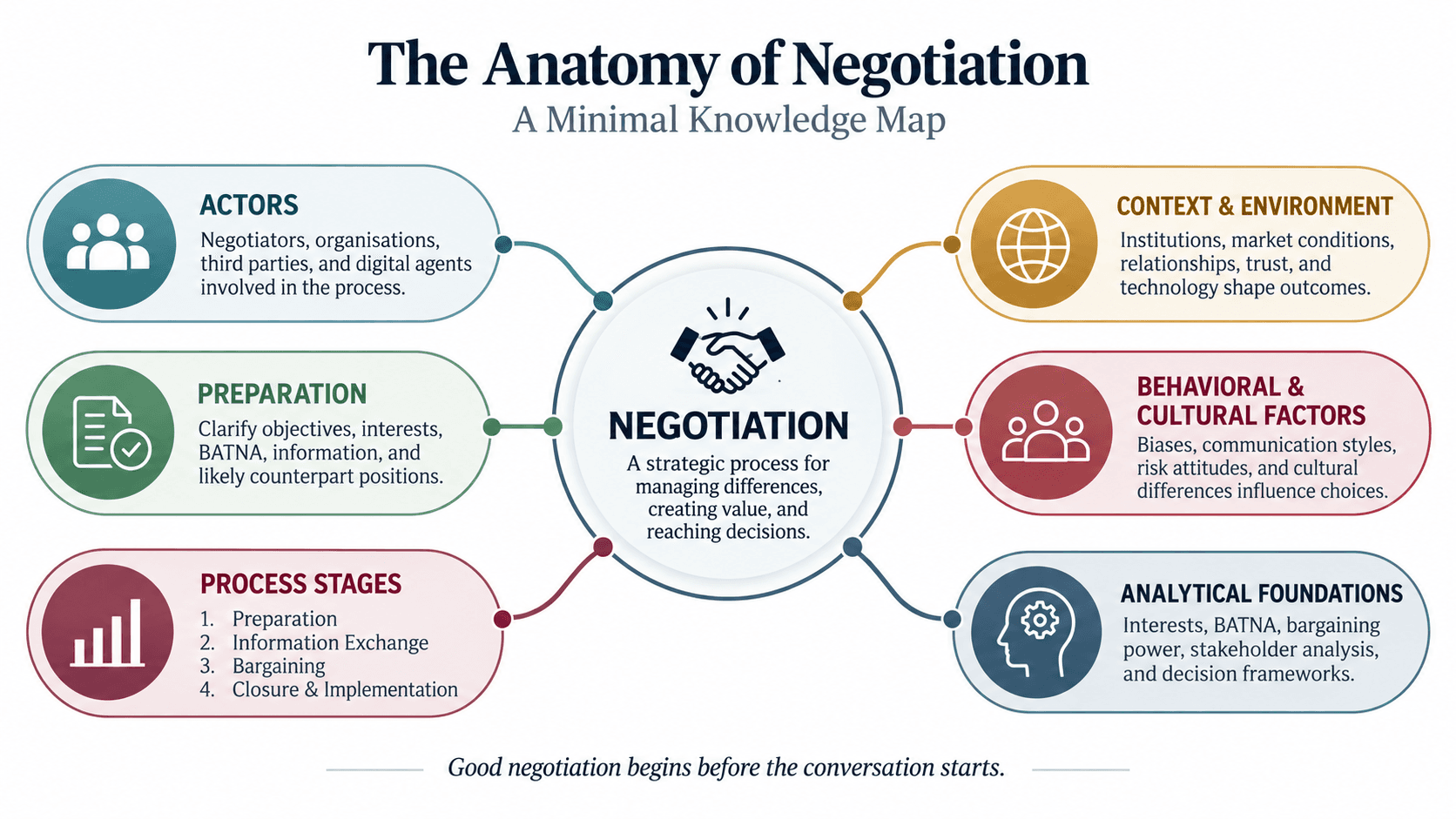
The most consequential decisions in a negotiation are often made before the participants enter the room. Yet preparation is frequently misunderstood as an internal exercise: defining our objectives, calculating acceptable concessions, developing arguments and identifying what we want to achieve. These activities are essential, but they represent only one dimension of effective preparation. Negotiation is inherently interactive. While we prepare our position, our counterparts are simultaneously evaluating their own interests, alternatives, expectations and bargaining power. Their preparation may be as sophisticated as ours, driven by entirely different assumptions or constrained by information we do not possess.
Effective preparation therefore requires understanding not only our own negotiating position, but also the position our counterparts are likely preparing to defend, the interests they seek to advance and the decisions they may already have made.
Preparing Beyond Our Own Position
From an economic perspective, negotiation constitutes strategic interaction under conditions of interdependence, imperfect information and potentially conflicting interests. Each party's choices influence the incentives and available options of others. Consequently, a negotiation strategy developed exclusively around one's own objectives risks overlooking the strategic reasoning of the counterpart.
Fisher, Ury and Patton (2011) emphasize the distinction between declared positions and underlying interests. Understanding this distinction becomes particularly important when applied to both sides. Knowing that a counterpart demands a lower price tells us relatively little unless we investigate why that demand matters, how important it is relative to other objectives and what alternatives might satisfy the underlying interest.
Consider a hypothetical negotiation between a hotel group and an international tour operator. The hotel seeks higher contractual rates, while the operator demands competitive prices. A narrowly prepared hotel management team may concentrate on defending its proposed rates. A more comprehensive approach would also examine the operator's likely preparation: anticipated demand, alternative accommodation capacity, distribution commitments, commercial risks and internal approval requirements.
The objective is not to predict every move. It is to develop evidence-informed assessments of the strategic circumstances shaping the other party's decisions.
The Negotiation Base: A Framework for Two-Sided Preparation
Our research, published in Tourism Critiques: Practice and Theory, introduces the concept of the Negotiation Base as an essential preparatory foundation preceding the negotiation process (Papadopoulou-Kelidou, Antonakakis, & Page, 2026).
The framework examines three fundamental dimensions of interest preferences: the type of interests pursued, their relative significance and the timeframe within which each party expects them to be satisfied. These dimensions interact with risk preferences and expectations about future developments. They are also influenced by organizational strategy, reputation, culture, relationships, interdependence, legal conditions, technology and inequalities of bargaining power.
Crucially, each negotiating party has its own Negotiation Base. Preparation therefore involves constructing a rigorous understanding of our own interests and strategic conditions while developing a reasoned assessment of the counterpart's corresponding dimensions.
What interests might the other party prioritize? Which demands are essential and which may be negotiable? Does the counterpart face short-term pressures that differ from our longer-term objectives? How much uncertainty can it tolerate? What future market developments might influence its expectations? Which dependencies strengthen or weaken its position?
These questions provide an analytical structure for evaluating the likely preparation of the counterpart, rather than relying on intuition or stereotypes.
A further contribution of the framework concerns time. Interests that initially appear incompatible may become negotiable when their timing is reconsidered. A party requiring immediate financial security may be able to reach agreement with another prioritizing long-term operational flexibility, provided the agreement appropriately distributes commitments and risks across different periods.
The Negotiation Base is also dynamic. New information, changing alternatives and evolving market conditions can modify either party's priorities during negotiations. Preparation must therefore remain a continuing analytical process rather than a checklist completed before the first meeting.
Assessing How the Counterpart Is Preparing
The Negotiation Base
Interest preferences and their strategic context
- Conditions
- Personality
- Reputation
- Structure of relationships
- Technology
- Power inequality
- Legal framework
- Perceptions
- Culture
- Level of interdependence
- Values
- Identity
- Goals
A dynamic preparatory framework for each negotiating party
Understanding the counterpart's Negotiation Base is not equivalent to knowing its confidential strategy. Executives should distinguish what is observable, what can reasonably be inferred and what remains uncertain.
A systematic assessment begins with the counterpart's business environment. Its market position, financial circumstances, organizational dependencies, previous contractual behavior and strategic announcements may offer indications of its priorities. The analysis should then consider its decision-making structure, negotiating authority, credible alternatives and possible responses to different proposals.
BATNA, the Best Alternative to a Negotiated Agreement, remains central to this assessment. Fisher, Ury and Patton (2011) establish its importance, while Sebenius (2017) highlights the complexity of alternatives and their relationship with bargaining power. However, preparation requires evaluating both our own alternatives and those potentially available to the counterpart.
An executive negotiating with a powerful supplier should therefore ask not only whether the organization can replace that supplier, but whether the supplier can replace the organization as a customer, how quickly it could do so and at what economic or strategic cost.
These assessments should be tested against evidence and updated through questioning, information exchange and observed behavior during negotiation. Their purpose is not to claim certainty about another party's intentions, but to reduce avoidable uncertainty and improve strategic judgment.
From Competing Positions to Negotiable Possibilities
Understanding both negotiating bases can reveal opportunities invisible to parties concentrating exclusively on their initial demands. Lax and Sebenius (1986) describe negotiation as involving both value creation and value claiming. The Negotiation Base provides a structured way to examine where the parties' underlying preferences might overlap, differ or be reconciled through alternative arrangements.
Differences in timing, risk tolerance, operational capabilities and strategic priorities may create possibilities for agreements that satisfy important interests without requiring identical preferences.
However, identifying potential compatibility does not guarantee agreement. An attractive proposal may still involve unacceptable dependencies, implementation costs or reputational risks. Preparation must therefore include clear acceptance criteria and an informed understanding of when withdrawal is preferable.
The purpose is not agreement at any cost. It is to determine whether a particular agreement creates sufficient value relative to the alternatives available.
Preparation as Strategic Intelligence
Behavioral research further illustrates the importance of disciplined preparation. Galinsky and Mussweiler (2001) demonstrate how initial offers can influence negotiation judgments through anchoring. Executives entering discussions without independently evaluated information may consequently become overly influenced by the counterpart's opening position.
Yet preparation cannot eliminate cognitive bias or information asymmetry entirely. What it can provide is a framework for examining assumptions, challenging interpretations and adjusting strategy when new evidence emerges.
For senior executives, this means moving beyond the question, “What should we say?” toward more demanding questions: What has the other side probably prepared? What does it believe about our position? Which assumptions shape its strategy? What information could change its preferences? Where might the two Negotiation Bases reveal opportunities for agreement?
Preparation is not simply the process of strengthening our position. It is the discipline of understanding the strategic interaction before attempting to influence it.
The quality of a negotiation is therefore shaped not only by how well we prepare ourselves, but also by how carefully we assess the preparation, incentives and potential responses of those sitting across the table.
From Research to Practice | Lambda Negotiations
At Lambda Negotiations, The Preparation Room applies an evidence-informed approach to strategic preparation, examining both the client's Negotiation Base and the likely interests, alternatives, risk preferences and expectations of the counterpart. Depending on the case, this may involve research, stakeholder analysis, scenario development and systematic assessment of bargaining conditions.
For senior executives facing particularly sensitive decisions, Private Advisory offers confidential strategic support. When multiple parties must reconcile different interests and priorities, The Alignment Room supports structured dialogue and coordination.
The objective is not to predict the counterpart's every move, but to prepare decision-makers to understand the strategic environment in which those moves may occur.
Before it matters, prepare for it.
References
- Fisher, R., Ury, W., & Patton, B. (2011). Getting to Yes: Negotiating Agreement Without Giving In (3rd ed.). Penguin Books.
- Galinsky, A. D., & Mussweiler, T. (2001). First offers as anchors: The role of perspective-taking and negotiator focus. Journal of Personality and Social Psychology, 81(4), 657–669. https://doi.org/10.1037/0022-3514.81.4.657
- Lax, D. A., & Sebenius, J. K. (1986). The Manager as Negotiator: Bargaining for Cooperation and Competitive Gain. Free Press.
- Papadopoulou-Kelidou, L., Antonakakis, N., & Page, S. J. (2026). Gatekeepers of demand: Lessons from pre-COVID hotel-tour operator contracting in the post-pandemic digital age. Tourism Critiques: Practice and Theory. https://doi.org/10.1108/TRC-01-2026-0002
- Sebenius, J. K. (2017). BATNAs in negotiation: Common errors and three kinds of “no.” Negotiation Journal, 33(2), 89–99. https://doi.org/10.1111/nejo.12176